Students in Señora Sanchez’s classroom recently brought color, culture, and creativity to the halls of IHS during her annual ofrenda contest, a tradition inspired by Día de los Muertos—The Day of the Dead. The project offered students the chance not only to explore an important Mexican holiday, but also to honor loved ones through beautifully crafted altars.
Sanchez, who first learned about the assignment 11 years ago in her first year of teaching, describes it as “a fantastic opportunity for students to learn about the Mexican holiday as well as about themselves and others.”
Día de los Muertos, celebrated on November 1 and 2, is a time when families in Mexico and other parts of Latin America gather to honor and remember those who have passed away. The Ofrenda, often decorated with candles, flowers, photos, and the deceased’s favorite foods, serves as a welcoming offering for the spirits of loved ones returning to visit. Sanchez shared that traditional elements include “candles, sugar skulls, Mexican cut paper (papel picado), salt, water, marigolds, photos, etc.” To her students, Sanchez defined an ofrenda as “a representation of a life that was lived,” emphasizing that personal items, from a hobby to a favorite food, help tell the story of the person being remembered.
To introduce the project, she taught her classes about the history and meaning of the holiday. Students watched a video featuring a young girl in Mexico creating an ofrenda for her grandmother, then viewed example projects and received step-by-step instructions. From there, the work began, as the classroom turned into a space filled with memories and personal stories.
Over the years, the assignment has evolved into a friendly competition. “I have been doing a top-three contest with this assignment for years,” Sanchez shared. “The projects are so beautiful, but there are always a handful that really go all out. These students deserve recognition.”
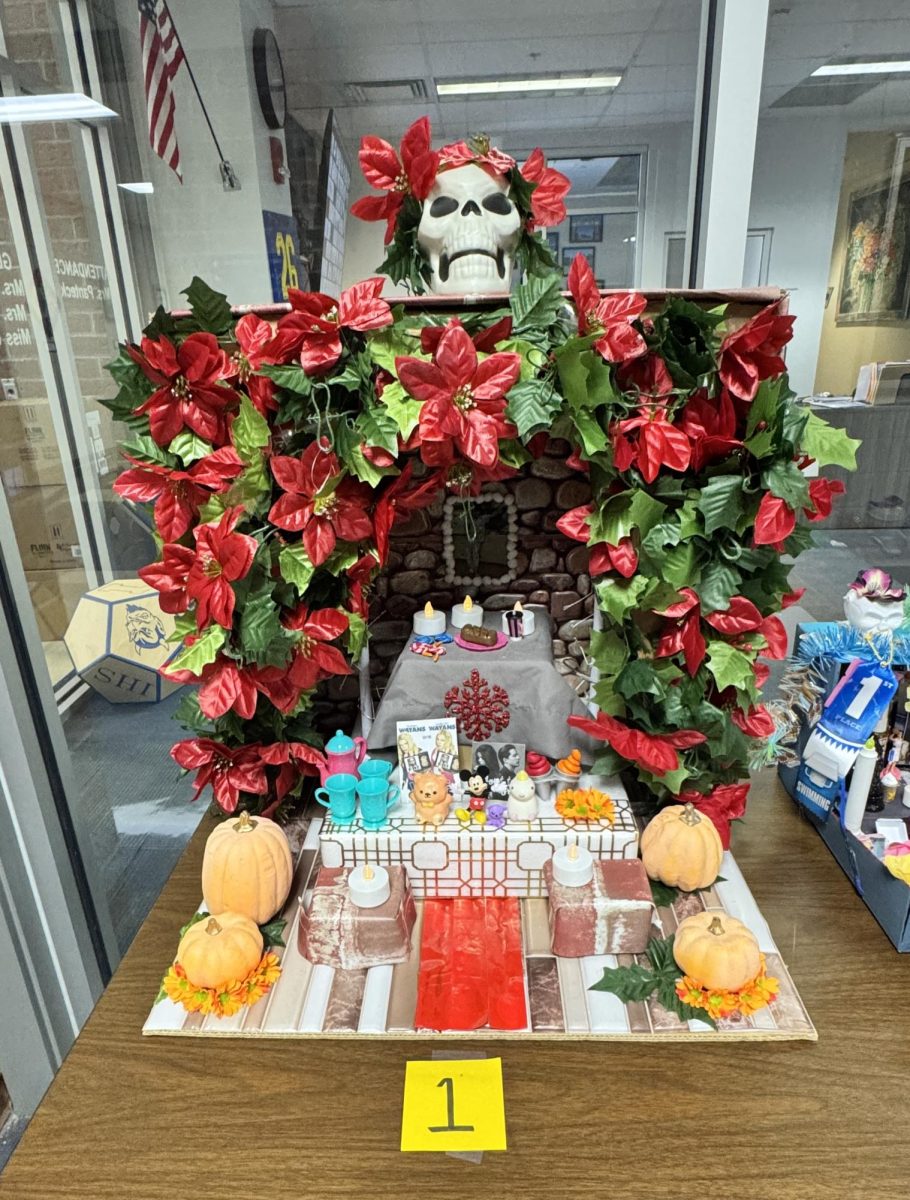
To judge the ofrendas, Sanchez carefully chose seven based on visual appeal, creativity, accuracy, and the meaningful details included in each altar. The top seven included Angel Sajan, Leah Creel, Sydney Swansiger, Nicole Mehosky, Quincy Carlisle, Julianna Cherny, and Luke Svadba. Next, the ofrendas were placed in the hallway, where staff were able to vote for the top three.
This year’s first-place winner, Sydney Swansiger, dedicated her ofrenda to herself after Sanchez suggested that approach. She adds, “I also chose myself because I felt that I could do my project most efficiently if I did it based on my own interests.” She included traditional elements like pan de muerto, incense, and marigolds, blending them with personal items that reflect her life. Her most meaningful item was a pin from a scouting camp. “I’ve been around scouting my whole life, and I think it has shaped me as a person,” Swansiger said. She adds, “Scouting is a very big part of my life.” While being intrigued with the other ofrendas, she thinks it was cool to see everyone else’s passions and interests, aside from her own. Swansiger would definitely want to do this project again, as “it would be cool to compare my interests now versus in a year.”
Second-place winner, Quincy Carlisle, created an emotional tribute to her grandfather. Carlisle said she wanted to “honor him and his legacy in another way, other than just remembering him and spreading his message.” With limited items to work with, she filled her ofrenda with objects that truly represented her grandfather, like his favorite pen and, most meaningful of all, the collar of Checkers, his beloved dog. “He was the last piece of my grandpa, so that collar by far means the most to me,” Carlisle explained. Reflecting on the contest, she said, “I was amazed at what people had done. Some of them were so extravagant that I was shocked they didn’t make it to the top seven. Everyone did an amazing job.” She added, “I would do this again in a heartbeat. I had so much fun, and I got to connect more with my dad and learn more about my grandpa.”
Third-place winner, Senior Sajan, honored herself by incorporating pumpkins and fall leaves to represent her love of autumn—something she hadn’t experienced growing up. “I used to live in the Middle East for most of my life, and I have never seen trees changing their color to orange, red, or yellow. Just thinking about the leaves changing color is fascinating,” she said. With her surprise of placing in the top three, Sajan added, “I thought I lost the contest because everyone did so well, and in fact, everyone deserved a prize for their effort.” Through this project, Sajan explains her thankfulness for the opportunity. “Through this project, I got to know more about myself, and I would love to do this project again next year.”
For Sanchez, the heart of this tradition is how special it becomes for students. “When students get hands-on experiences like this, it becomes personal,” she adds. “Losing loved ones is never easy,” she said, “but Day of the Dead focuses more on the life that was lived rather than the life that was lost.” The top three winners, along with all participants, clearly embraced her message as they celebrated culture, honored life, and created ofrendas filled with creativity, meaning, and emotion.