








More than 33 million Americans live with a food allergy, and my sister Allison Suhy was one of them.
Allison, known to many as Ally, graduated from Independence High School in 2017 two years before my sister Jenna. After high school Ally headed to Ohio University in Athens to pursue an education degree. Tragically, Ally died from an anaphylactic reaction during her time at OU. In the aftermath, my parents, Becca and Michael Suhy, turned our tragedy into advocacy by establishing the Allison Rose Foundation.
The Allison Rose Foundation [ARF] is dedicated to supporting food allergy families through education, awareness, research, and advocacy. Food allergies affect millions of individuals and families every day, yet are often misunderstood. This Foundation is on a mission to change that. By uniting medical professionals, educators, and advocates, they provide the tools and support necessary to save lives.
Today, ARF travels around Ohio and the United States educating people about food allergies to schools, universities, and restaurants.
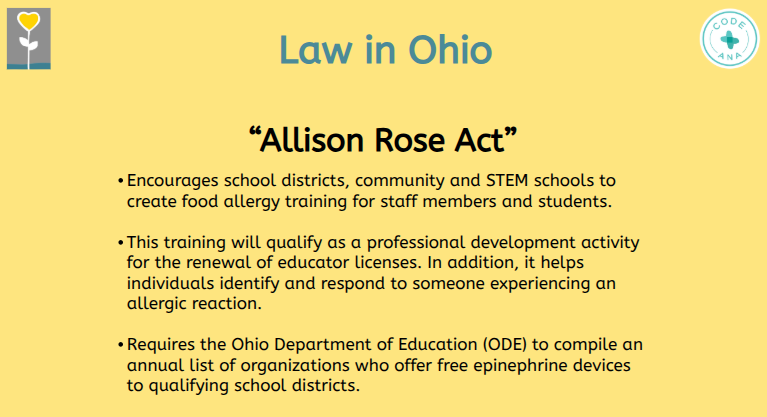
In April of 2021 the Ohio legislature passed Bill 231, also known as the Allison Rose Act; this bill requires Ohio schools to train staff and students on food allergy safety. It also encourages them to create a food-allergy protection policy, improves access to epinephrine, all to better prevent and respond to allergic reactions in schools.
ARF partners with doctors from all over the country to help develop the training that many have received to this day. The Medical Advisory Board consists of Dr. Lisa Bartnikus (Boston Children’s Hospital), Dr. Ruchi Gupta (Lurie Children’s Hospital), Dr. Alice Hoyt (Coda Ana), Dr. Sandra Hong (Cleveland Clinic), Dr. Katie Marks-Cogan (Clear Allergy), Dr. Princess Ogbogu (University Hospital), Dr. Brian Schroer (Cleveland Clinic), Dr. Ruchi Shah (Cleveland Clinic), Dr. Julie Sterbank (MetroHealth), and Dr. David Stukus (Nationwide Children’s Hospital).
One of the ARF board certified doctors, Dr. Alice Hoyt designed Code Ana, a non-profit program that equips schools to be prepared for medical emergencies, like anaphylaxis through evidence-based medical information and innovative, school-tailored medical response planning. It developed our allergist-driven training program for medical professionals.
Information for Students
What students should know about food allergies: Sudden hives, swelling, trouble breathing, or throwing up usually mean a food allergy, while headaches, stomach upset, and feeling foggy point to a food intolerance. Food allergies are serious and need epinephrine, but food intolerances aren’t dangerous and can be handled with simple over-the-counter medicine.
Epinephrine is the only medication that STOPS the anaphylactic reaction. Antihistamines (i.e. Benadryl) do NOT STOP the anaphylactic reaction.
The Allison Rose Foundation does a challenge for 9-12 grade students in their Health classes. It is called the Allison Rose Challenge, it is where the teacher gives each student an “allergy” and that student then has to try to avoid said allergy for a week. This is to give the students a first hand experience on how hard it is to deal with an allergy and the challenges that accompany it.
The Allison Rose Foundation turned a tragedy into a successful non-profit to educate families about food allergies so no other family has to go through the hardships of losing their loved ones to anaphylaxis.
Visit the Allison Rose Foundation online!