




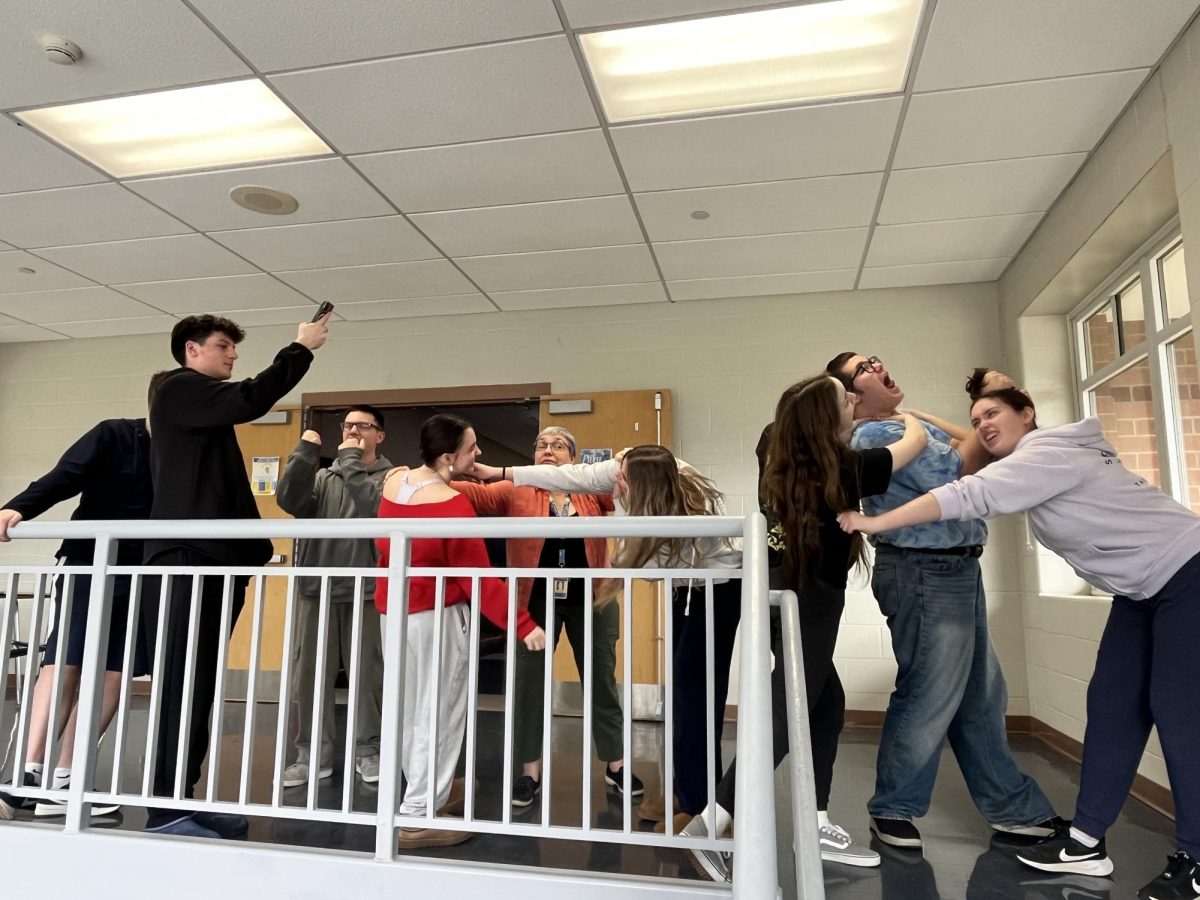




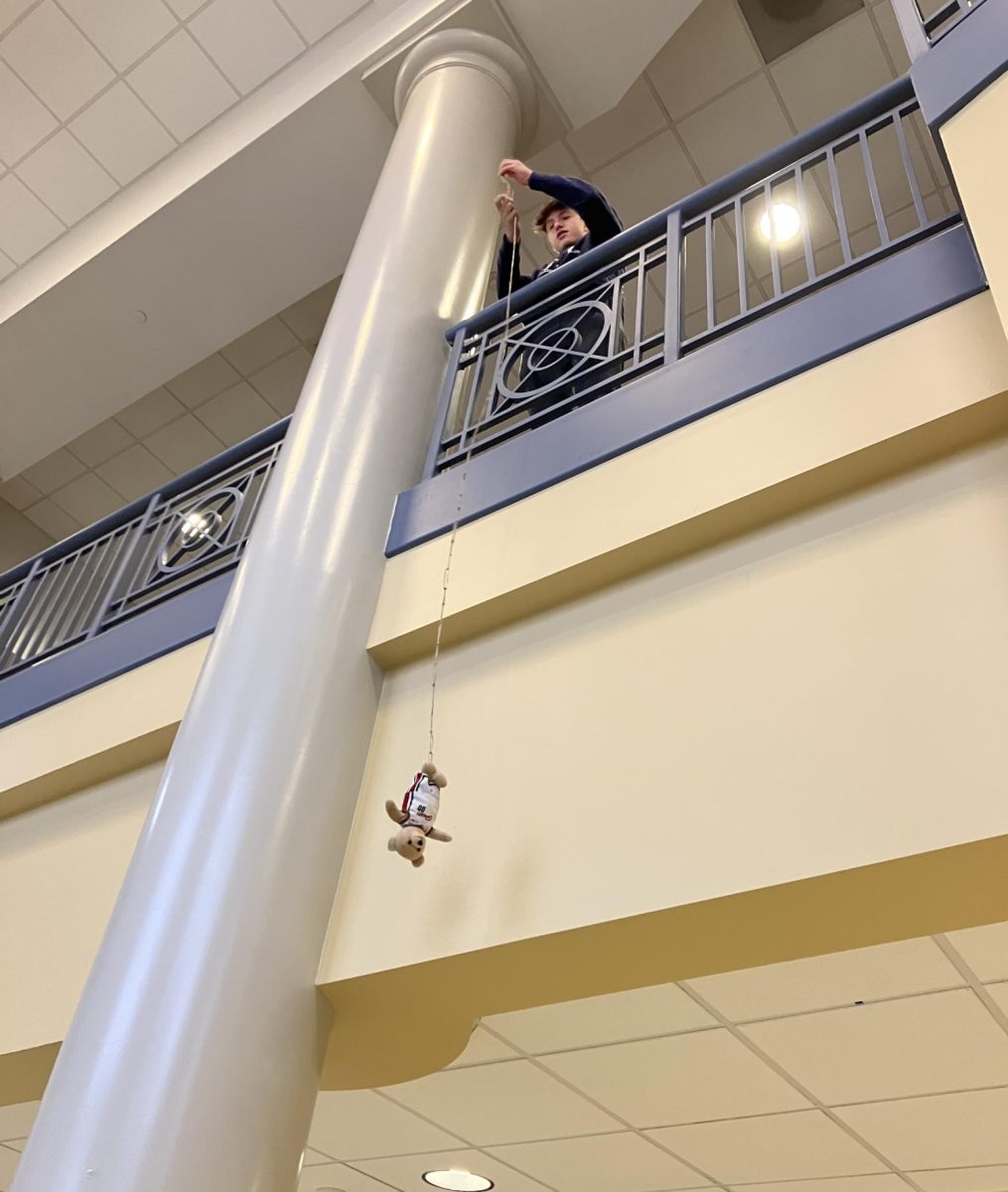
Students in Statistics and Probability dropped Barbies from the main lobby balcony for the sixth annual Barbie Bungee competition on Thursday, November 20.
Barbie Bungee is a math activity in which students attach rubber bands to a contestant: a Barbie, stuffed animal or action figure. The students drop the contestant from the main lobby balcony in the hopes of creating the longest bungee without their contestant touching the ground. Stats students were introduced to the activity at the end of October.
Stats teacher Mrs. Sheryl Luoma tasked them with collecting data for how far the Barbies traveled with one rubber band, two rubber bands and so on, with a maximum of seven rubber bands. They then use the data to predict how many rubber bands they need in order to drop their contestant from the balcony at a height of 5.3 meters. The contestant who gets closest to the floor without touching it is the winner.
Winners were senior Ryan Mack in the first period stats class and seniors Sam Bernhardt and Samantha Haller in the eighth period class. Both teams followed the least squares regression line of their data and subtracted a few rubber bands to prevent their contestant from hitting the floor.
“I learned that data is more reliable than intuition,” Mack said. “The fall distance doesn’t increase in a perfectly straight line at first, and you really have to trust the math to get the best result.”
Luoma hoped her students would take this lesson. “The students learned that one should not be confident in predictions made by extrapolation but that regression can be a powerful tool to model relationships of variables.”
AP Statistics held the Barbie Bungee finale earlier in the year on October 21. The winner of that challenge was senior Emily Gibbons. The Advanced Quantitative Reasoning class, taught by Mrs. Darlene Stefanski, held their own Barbie Bungee on November 19, but it was not a competition.